
Art of the Fly - An update!
What started as a box of old fishing lures at an auction turned into a full-blown adventure, the kind where you don’t realize you’ve taken the bait until you’re already reeled in.
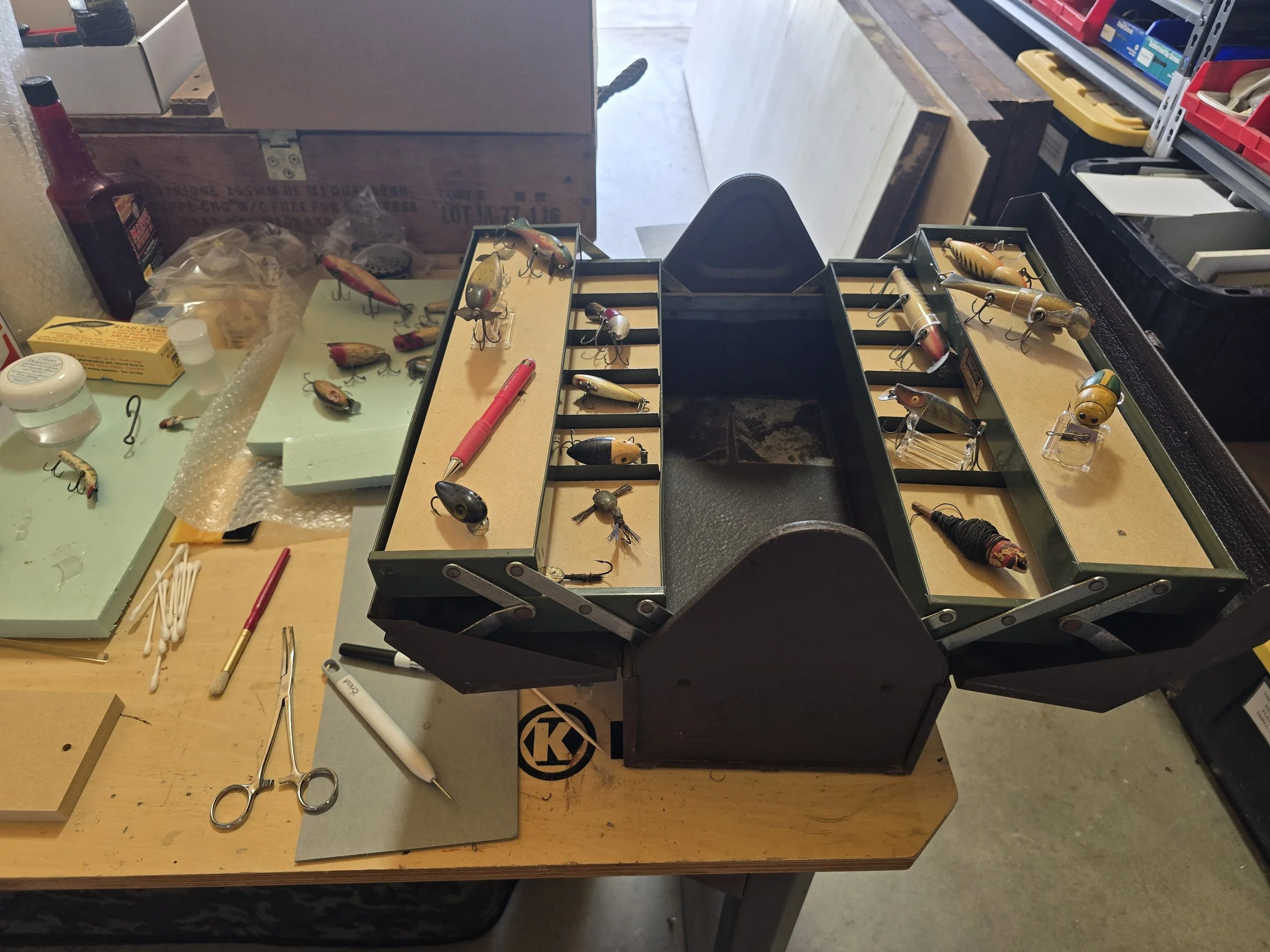
At first glance, it looked more like a tetanus shot waiting to happen that an exhibit possibility. Rusty hooks. Tarnished reels. Dry-rotten fishing line that probably hadn’t seen water since Eisenhower was in office. But somewhere in the back of my mind, a little voice cast a line: There’s a story here.
And that’s the thing about fishing — and history, for that matter. Sometimes the best catches are the ones hiding beneath the surface.
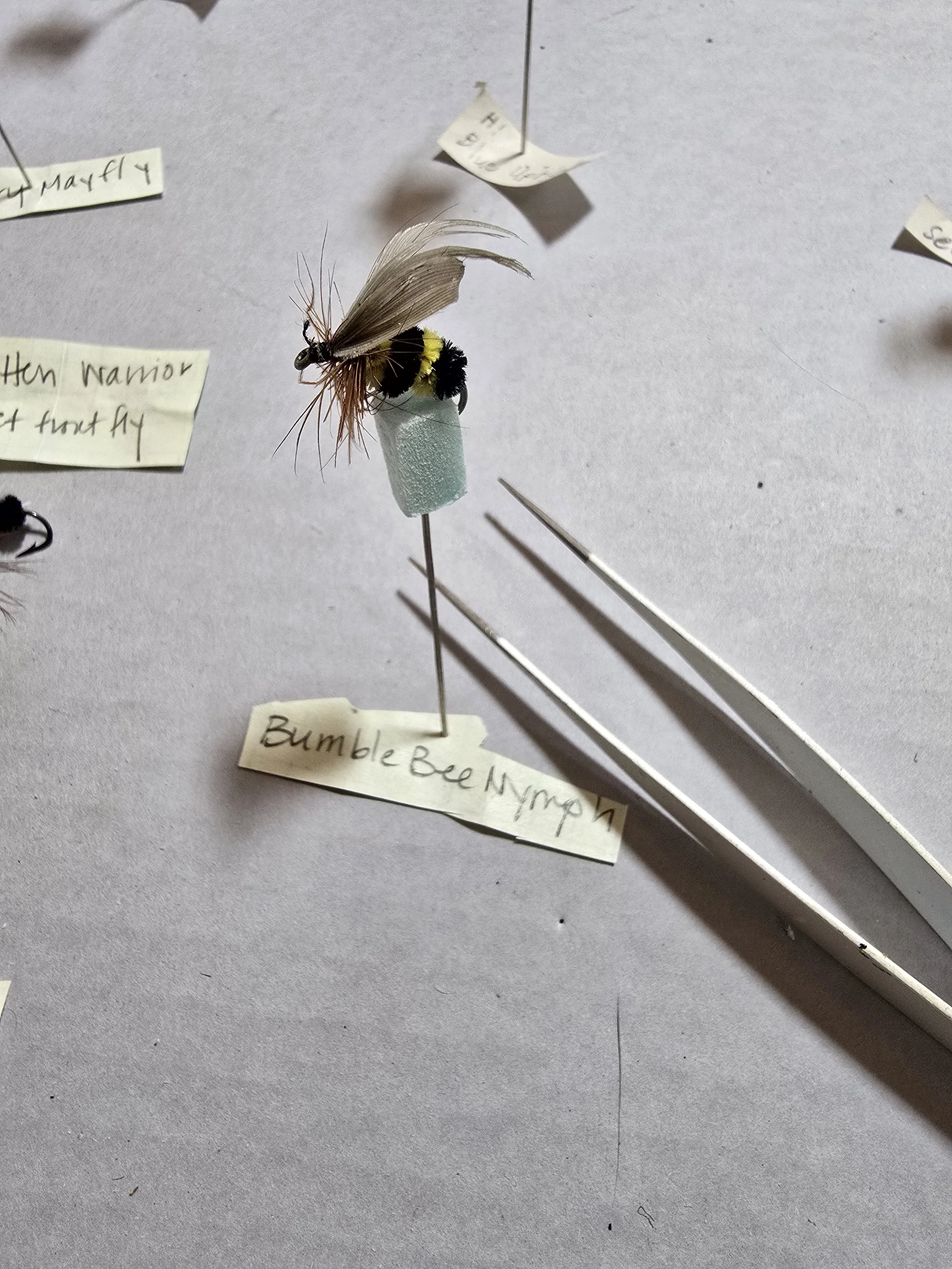
Bumble Bee Nymph
Fishing has a way of hooking our interest. Mention it, and suddenly people drift into stories about hot summer afternoons, the steady slap of water against a dock, the smell of sunscreen and bait shops, and that magical heartbeat-skipping moment when the rod tip twitches. Fishing isn’t always about catching fish. Sometimes it’s about slowing the current of life just long enough to notice what matters.
Before I knew it, the auctioneer’s hammer dropped, and I became the proud, if slightly confused, owner of a box of vintage fishing gear. At the time, I couldn’t have told you the difference between a lure and a plug or identified a casting rod from a fly rod if my tackle box depended on it. So, like any good angler chasing a mystery, I started digging. And what a catch it turned out to be.
The history of fishing lures is a deep story of ingenuity, artistry, science, and downright obsession. Humans have spent centuries trying to figure out how to get a fish to bite a lure. The answers are surprisingly beautiful. Hand-painted wooden plugs. Delicate fly patterns tied feather by feather. Gleaming spoons are engineered to flash like injured baitfish. Every lure tells a story about innovation, patience, and the eternal optimism of anglers convinced that this next cast will be the one.
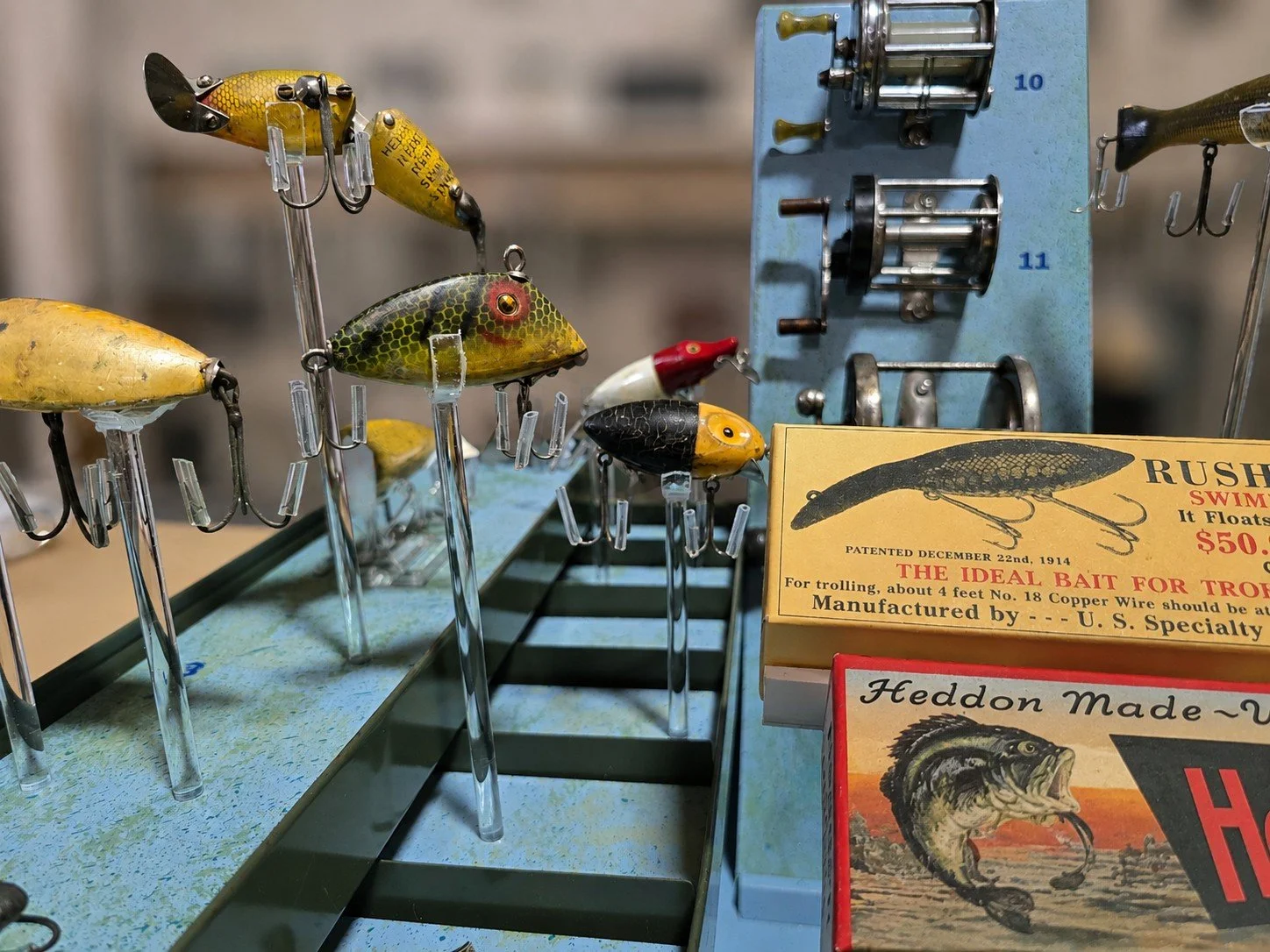
Pico Perch Lure
Soon the imagination started running like a hooked muskie. Design concepts flooded the desktops, graphics hit the drawing board, and engineering plans were tacked to the shop walls. For weeks, the shop has been buzzing as we put the finishing touches on our newest traveling exhibit: The Art of the Lure.
There were custom crates to build, countless tiny mounts to fabricate for delicate flies, and more than one unfortunate incident involving CA glue and my fingertips becoming permanently acquainted. We’ve measured, mounted, painted, polished, packed, and probably inhaled enough sawdust to build a small canoe. But every minute of it was worth it.
Now, after months of research, design, fabrication, and more than a few tangled lines along the way, we’re thrilled to announce that The Art of the Lure is officially on display at the wonderful Cleo Redd Fisher Museum in the charming town of Loudonville.
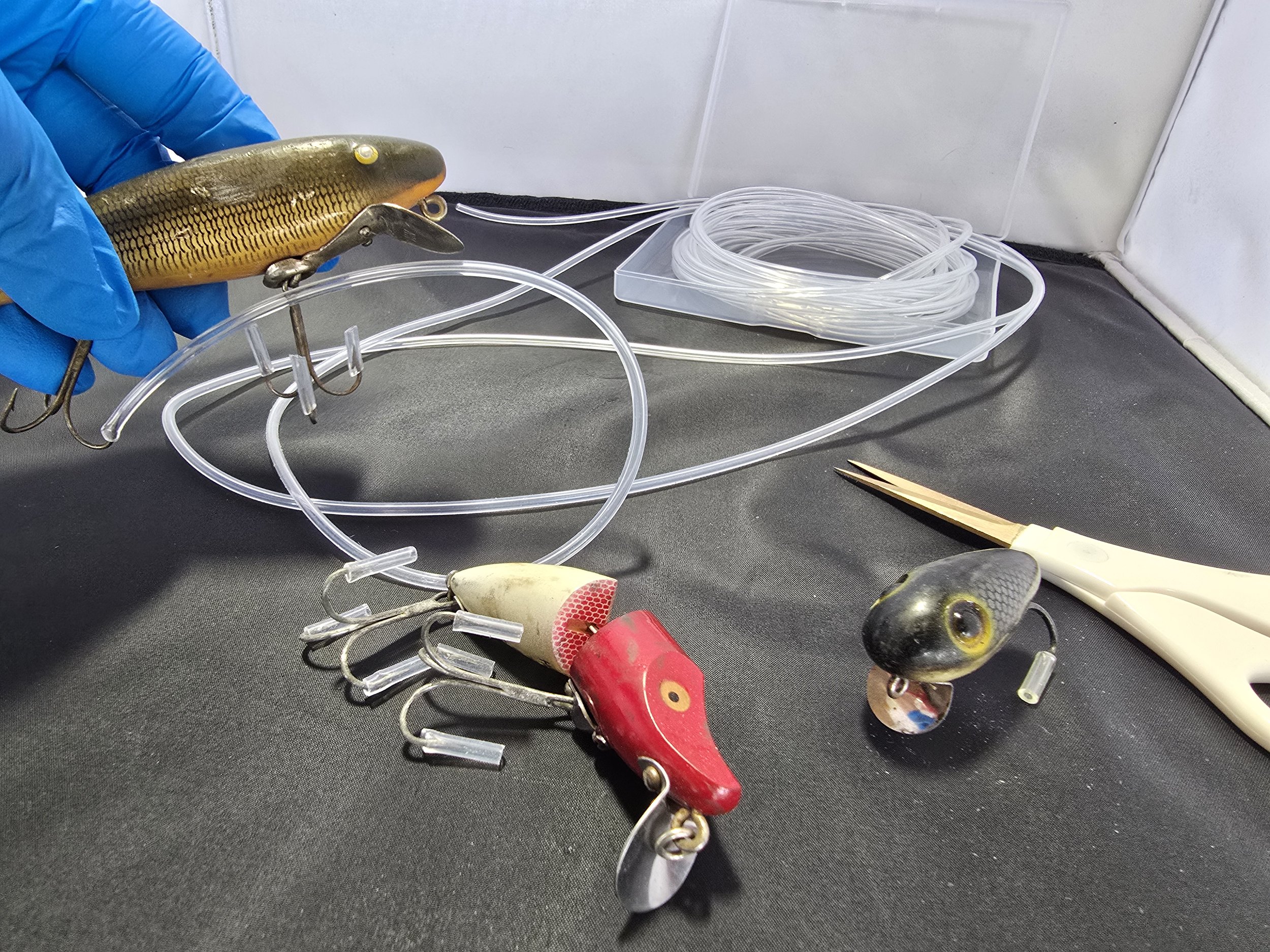
Anti-band aid Brigade is a must.
This summer, thousands of campers, anglers, hikers, and outdoor-loving families will travel to the beautiful Mohican State Park region of central Ohio. They’ll paddle rivers, hike trails, roast marshmallows, and hopefully, somewhere between the campground and the canoe launch, wander into the museum for a little unexpected inspiration.
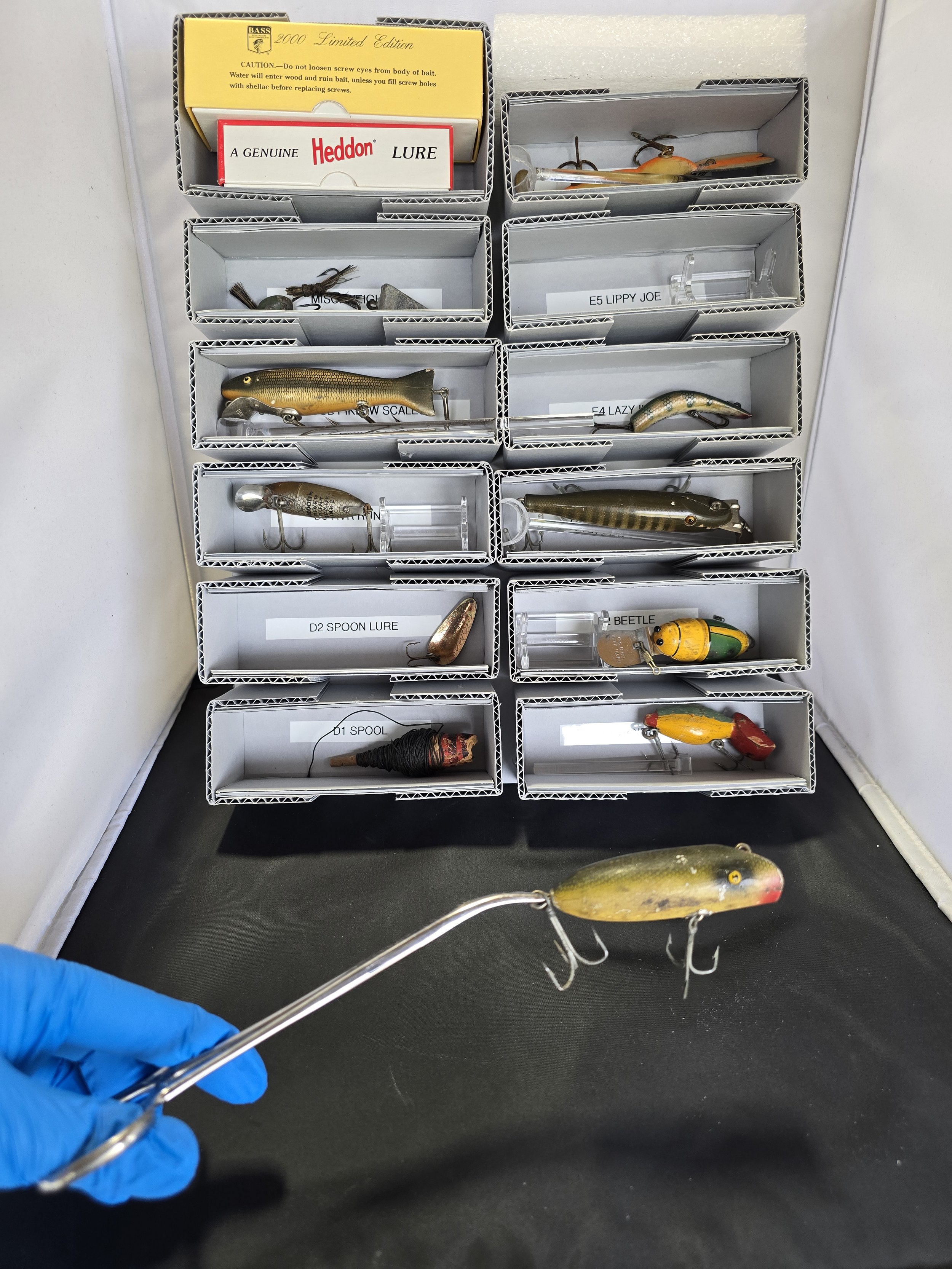
A nesting box for each lure.
Maybe they’ll point at an old lure and remember fishing with their grandfather. Maybe a child will discover fly fishing for the first time. Maybe someone will simply pause long enough to appreciate the artistry hidden inside an ordinary tackle box. That’s the real catch.
On this Pearl Harbor Day 2025
On this Pearl Harbor Day, I’m reminded why it matters to share our passions openly and unapologetically, especially when those passions help preserve the stories of those who served.
Six years ago today, Museum Pros installed our very first traveling exhibit. I still recall the electric mix of nerves and excitement as we began setting each artifact. When museum guests approached the display, reading slowly and intently, my heart pounded. It was the unmistakable feeling of putting your passion on full display for the world to see.
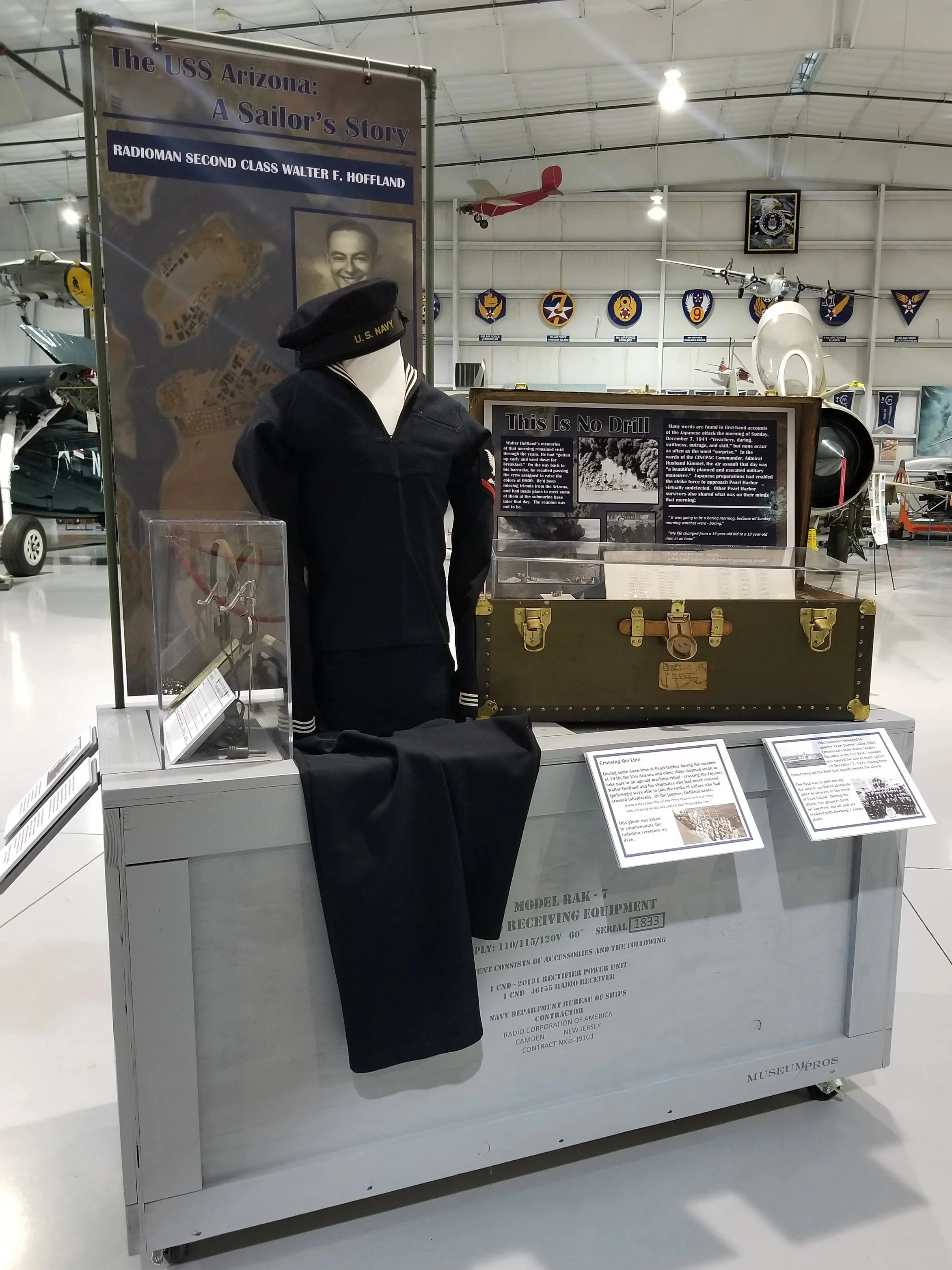
That inaugural exhibit, A Sailor’s Story, was created for Airbase Arizona in Mesa. One of their docents was the son-in-law of a Pearl Harbor survivor, and his wife was determined to share her father’s service story. We were honored to help bring it forward.
Her father, Navy Radioman 2C Walter Hoffland, served aboard the USS Arizona. Only months before the attack, he was transferred to CINCPAC Headquarters, though he remained close with his shipmates and planned to join them for breakfast on the morning of December 7. Instead, he watched Japanese planes descend on Pearl Harbor.
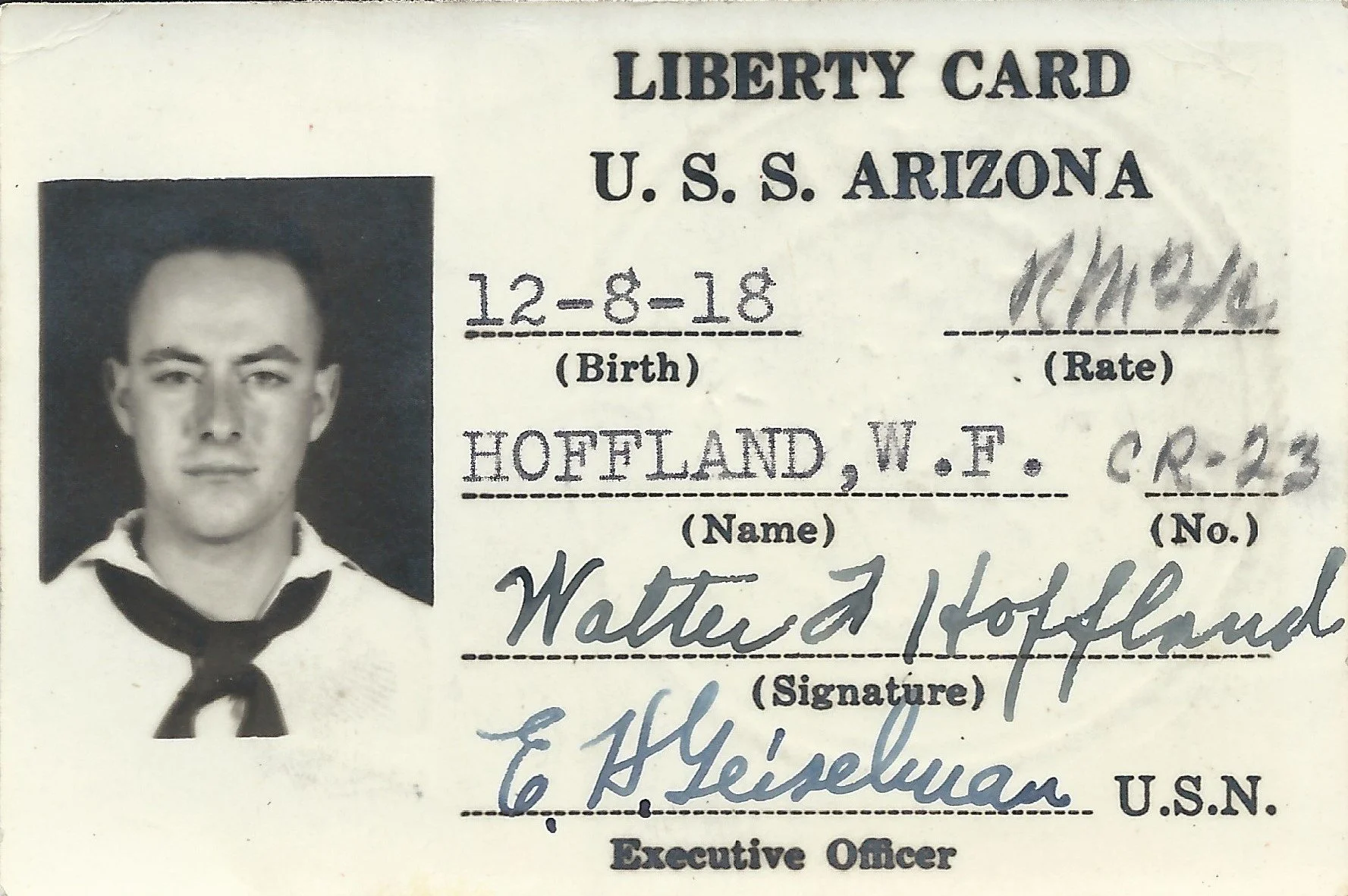
Unable to help his former crew aboard the Arizona, Hoffland climbed to the roof of his building with a rifle and fired at the attacking aircraft. In the chaos, a piece of shrapnel ricocheted off the roof and landed beside him. He picked up that jagged fragment and carried it with him throughout his Navy career as a reminder of the day that shaped so many lives.
That same piece of shrapnel became the centerpiece of A Sailor’s Story. On installation day, as I watched guests lean in, read, cry, and photograph the display, I felt profoundly grateful, not only to tell Hoffland’s story, but to share it.
In the years since, that sensation has never faded. My nerves still jangle. My heart still races. Every installation is another moment of stepping forward boldly, offering something meaningful to the world, and hoping it resonates.
This Pearl Harbor Day, I’m especially mindful of the responsibility and privilege of sharing veterans’ stories. History connects us. It holds our triumphs and our tragedies. It guides us, warns us, and inspires us. But only if we choose to listen, and only if we choose to tell it.

Research on the Fly
Working on traveling exhibitions is like casting a line into uncharted waters—you never know what you’ll reel in. Even topics I thought I’d never be hooked on spring to life when I dive in and study the people who lived them.
This week, the Museum Pros team is putting the finishing touches on a traveling exhibit we’ve been developing for months: vintage fishing. I’ve wet a line a few times myself—Northern Idaho’s South Fork of the Payette, Montana’s Missouri River south of Great Falls, a couple of trips in Virginia—but I had no idea about the deep currents of history beneath the surface. The evolution of lures, the subtle difference between fly and spin cast techniques, and the lifetimes anglers spent perfecting ways to trick a fish—these are stories that make the past shimmer like sunlight on moving water.


Throughout the process, I’ve gained enormous respect for the bond between anglers and the rivers, lakes, and streams they cherish. Those who know the water intimately are often the first to step up to protect it, casting their conservation nets wide to ensure future generations can also feel the thrill of the catch.
This vintage fishing exhibit, celebrating the art of plug baits and delicate flies alike, will soon be ready for rental. We can’t wait to share these tales of skill, patience, and passion with venues across the country—inviting visitors to cast their curiosity and see history come alive.
Word of the Week: Maquette
One of the hardest things for me to wrap my mind around when approaching a new exhibit is scale. I know what the new display looks like in my head – but how to translate that design into 3D often eludes me. The same challenge arose years ago when I first approached a fabricator to discuss building my traveling trunk concept. I just couldn’t get what was in my brain out of my mouth in ANY words that were comprehensible.
My solution at the time was to mock-up, in 3D, a little foam core model. My first attempt was crude, but effective. I am no architect, but I can cut a straight line, and this was sufficient to get my point across. Since this initiation into miniature mock-ups, I have used the technique on several occasions during the exhibit design process. The first exhibit case I mocked-up was for Tubac Presidio State Historic Park. A photo of the mock-up and the finished case are below.

This week – picture a huge light bulb over my head – I learned that this is a bona fide artist technique, and it has a name – maquette.
Exhibit design and fabrication is incredibly unique work. It engages so many interdisciplinary skills to produce a specific product. I often say that creating history exhibitions is like writing a book, boiling it down to poetry, and then illustrating it in 3D. Add to that, the fact that your work is thrown out there for public review and scrutiny. It’s not always easy, but little hacks like creating maquette often are just the need to see that a concept is viable.
This week – the task was to create a small changing gallery for Superstition Mountain Museum. It is an intimate space, just 9 feet deep by 6 feet wide. Faced with the challenge of scale, I started by trying to get my thoughts out in the form of a maquette. It’s crude, perhaps, but effective, and I am happy to share it with you – handwritten scribbles and all!

Fabrication Shop Adventures – Spiders and Flies and Pill Bugs!
My morning routine is almost always the same – wake up, brush teeth, brew coffee, watch sunrise. Wherever I am, if there is a sunrise to enjoy, I “cheers” it with a cup of black coffee. Unfortunately, the last several weeks, the morning routine has been rudely interrupted by hundreds of invaders – bugs!
As many of you know, Museum Pros operations recently relocated to Central Texas. The decision to do so was not undertaken lightly and being an “I have to have a list” sort of person, I researched and articulated all the pros and cons of establishing a home and fabrication shop there. Or so I thought. I left out one little detail. Well, I left out thousands of little details – bugs. There are tons of bugs here. Most prevalent are Pill Bugs, or rolly polies roly polys rolly polys – well whatever. There are also big, healthy house spiders, Junebugs that catapult themselves at the windows in the evenings and flies.
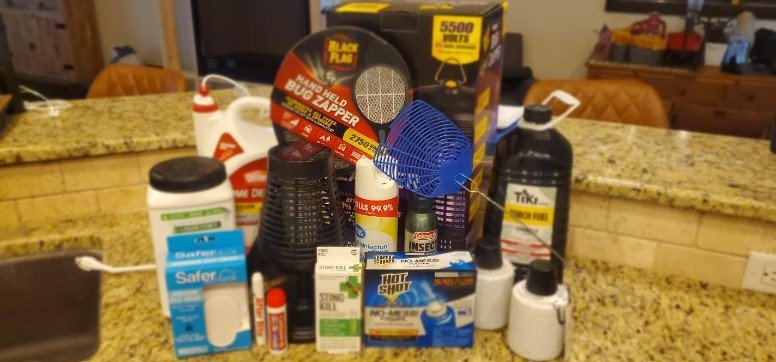
Thankfully none of our little invaders are harmful to humans if you don’t consider the annoyance factor. And normally I don’t mind bugs, but this is ridiculous. Today, we armed ourselves for war, photo below. My favorite new shop toy is not a saw or drill or fancy knife, but a battery-operated fly-electrocuting tennis racket thingy that I wield with aplomb. Welcome to Texas!
It's the Little Things
This week we installed a new exhibit in the Museum at Tubac Presidio State Historic Park in Arizona. (Insert happy dance here!) It was both demanding and rewarding as each installation tends to be - and by the end of the work, we were thrilled with the outcome.
This case is the third Ancestral O'odham exhibit we've created this year alone, and as it developed one of the biggest challenges was how to make it fresh and different from the others. In pursuit of a unique feature for Tubac, we worked out a way to add depth to the display case, both literally - by using the glass as a display surface, and digitally - by adding QR codes for more interpretation.
Creating displays on the interior surface of the glass was pretty easy. Gorgeous photos printed on vinyl with second surface adhesive and viola! See our beautiful O'odham woman and her prickly pear harvest in the photo below.
The QR Code was trickier. After some mental noodling, we visited the local craft store and picked up inexpensive magnifying glasses. QR codes were printed on cardstock and fitted into the ring part, and the whole thing, mounted on the front of the display plinth, became the sign, reading "Take a closer look at an Ancestral O'odham lithic." Pretty cool, huh!?
Simple, economic, effective solutions - that's the M//P way!


How to Revise and Outdated Exhibit
This blog is dedicated to the glass display case – you know – the one that was donated to your museum in the 1980s by a well-meaning retailer after their remodeling project. These cases are huge, heavy, and if you are unlucky enough to have the kind that load from the rear – practically impossible to make look attractive. I have seen these in nearly every small museum (and some large) across the country. In fact, I worked with one museum that purchased these intentionally!

This week’s “HOW TO” is about building a foundation for displays and the dreaded glass case is a great example to work with. Even though curators hate these museum relics, they serve a purpose and because we can’t afford the new convenient cases with magnets and lift booms, and sliding doors that don’t break your back, we have to dress them as best we can. Here are a few rules to help:
Add Color. Just because glass is inert doesn’t mean you have to schlop artifacts down and stick an ID tag alongside. Create a base for your objects with a flat piece of foamcore, MDF, or even cardboard, wrapped in a colored fabric. A solid base in a coordinated fabric color makes a huge difference in the way an object appears. Here are a few things to remember for making this hack work:
Cut your base material neatly. Squares and rectangles cut just slightly larger than the object work best. Use a straight edge and sharp craft knife for best results.
Any fabric that is going to come in direct contact with an artifact should be laundered first. Use a “free” detergent and no fabric softener. Iron the fabric, cut it so it wraps around the cardboard base like a present, and then hot glue the edges on the underside.
Lift It Up. One step above a flat base for your objects is a plinth. A plinth is a little box that lifts artifacts. I find it amazing that you can take a thing – anything – dust it gently, put it on a plinth and suddenly it looks amazing. Several plinths of differing sizes and heights can be scattered throughout a case to make the contents look interesting and to highlight the most important ones. Plinth can be custom made with MDF or plywood, but if you don’t have the equipment, you can also try these hacks:
Wrap a sturdy cardboard box with fabric (see steps above). Pull the fabric tight and wrap the box like you would a present, with folded edges. Glue everything neatly with a hot glue gun.
Buy craft squares at your local crafting store or on amazon and paint them to match the color palette of your display. Here are a few I’ve used in the past.
In a pinch, wrap acrylic vitrines with fabric. When you glue, be sure not to adhere the fabric to the acrylic and these can be used again in the future.
When you paint items that are going to come in contact with artifacts, use a barrier layer between the two when you can. A small strip of muslin, a piece of mylar sheeting, or acid free tissue paper tucked under the artifact will help keep it from damage.
Anytime you include paint in your museum display case, let is cure completely before adding any artifacts.
Below are a few before and after shots of glass cases we’ve gussied up over the years using these simple techniques. A how-to video is also on our YouTube Channel @museumprosllc6500
Next week, we’ll throw out suggestions for signs. Until then, happy curating!


How to Read a Western Town -- Part 2
We arrived in Rapid City, South Dakota after sundown. Having traveled through remote towns with little population for hours, it was clear, even in the dark, that Rapid City was large by comparison. With a population of 76,000, Rapid City is the second largest city in the state. From the hotel room the next morning, we could see the typical interstate stuff – chain restaurants and gas stations. Finding downtown would be more challenging than a couple turns to locate Main Street.
Like many western towns, and especially those in the high plains, Rapid City is surrounded by bluffs. If you’ve ever experienced the biting wind in those locations, you know why. That makes the first rule of finding the old part of town simple – go low. Follow the contour of the land to a low spot and you are likely to find water. Humans cling to water; a critical fact in the west where water is scarce. The earliest inhabitants of the area would have been near a water source.
Once you go low, watch for streets to get narrower and buildings to get closer together. Unlike eastern and European cities where original streets evolved in a spoke pattern emanating from a town square, castle, or church, western towns in the U.S. are most often laid out in grids. Streets run east/west, and north/south, and often, the original two roads run parallel, each being one-way and almost always east and west. It is still possible to find Main Street in larger cities, but also common is the practice of naming early streets after presidents. Opposing streets are numbered.


In Rapid City, the streets defy the presidential naming tradition, but take on a different kind of ode to the heads of state. In recent years, after the decline of downtown commerce, community leaders launched a campaign to revive downtown and identify Rapid City as the City of Presidents. With Mount Rushmore just a few miles to the south, it seemed a logical plan to rally public interest. Today, the downtown area is busy with merchants, and outdoor attractions and events, and a sculpture of a U.S. president adorns each corner.
Beyond the business district of a western downtown lie the residential sections. Here too, clues help identify the earliest homes and properties, and those of the wealthy and those of the poor. There is literally a “right” and “wrong” side of the tracks. To find the original homes, look to the corners of intersecting streets. Those houses are likely larger, older, and statelier than the fill-ins between street corners. Older homes will have larger trees and outbuildings like detached garages/carriage houses. In factory towns and mining towns, worker housing may have been “company owned,” meaning the mine or factory-built housing for its employees. These houses are small, crisp, and similar in appearance. They often line up neatly in a row along the street or near the railroad tracks.
Our trek to and through Rapid City was fun and fascinating. It bears a great deal of similarity to other western towns, and yet, had a spirit of its own. There is a balance of old and new, of purposed and restored that gave the whole place a funky vibe. Even though I am a sucker for good architecture, historic districts, and old houses, the best part of Rapid City was the people. We chatted with shop keepers, bar tenders, and a city council guy who was serving up free coffee at the community ice skating rink. Everyone we encountered was pleasant and proud of their hometown.
Tri-State Warbird Museum - Opening Lecture
We so are looking forward to our lecture to launch the Military Mapping Maidens travelling exhibit for its stay in Batavia, OH. Check out Aviation Trail’s announcement & stay tuned for our posting of the lecture
Aviation Trail's Lecture Series
How to Read a Western Town -- Part 1

Most of our travels since starting Museum Pros have been business - related. While "on the clock" I make a point to use every mile to explore roadside history and small museums in remote locations. This weekend, we traveled to visit family, but even so, I couldn't resist the urge to get off the highway and explore the (few) towns along the way.
8 am - Denver Airport. It was cold! We headed north through Brighton looking for a breakfast spot. Several miles and several degrees colder later, we found a fun place in Hudson, CO. You know you're in the northwest when a bison or two watch over your green chile omelet!


10 am - A junction in the road took us off Highway 71 onto Old Highway 71, and the town of Fort Morgan. Western towns make it pretty easy to find the historic downtown when they name the main road, well Main. Such was Fort Morgan. Art deco architecture on the bank and Masonic Lodge hinted at the decade when money was made, and the huge grain elevator just across the railroad suggested how that money was made.
Noon - Nebraska. It just got colder. Towns along the 71 were small and corn fields were big. The Plains Historical Museum in Kimball caught our eye (although it was closed) as did an abandoned church and schoolhouse.
3 pm - South Dakota. Colder still. Incredibly cold for a desert dweller. We crossed into the high plains en route to Rapid City.
More to come in Part 2 - Rapid City to Mount Rushmore.

MAA - Lunch Bites - Exhibits on a Shoestring
Check out our thoughts & tips on creating exhibits on a shoestring with the Museum Association of Arizona’s Lunch Bites Session

Ancient Pottery, Current Passion
People often ask me how I became interested in museums and history. The answer has never eluded me, in fact, I remember the exact event that inspired it – a trip to the SRP Hohokam gallery, shortly after my family moved to Phoenix in the 1970s. I don’t know what took us to the SRP headquarters, but I remember the story. Ancient people, advanced technology, and the belief at the time, a mysterious disappearance. In the decades that followed, my love for history grew, but I never really studied the Hohokam in-depth.
This fall, I have three contracted projects that bring me back to that first excitement for the prehistory of the Sonoran Desert. With these projects I am able to dig into new research and gain an appreciation for not only the lifestyles of the Hohokam, but the material culture they left behind as well. One of the projects Museum Pros is working up is a new pottery exhibit for the City of Tolleson Public Library. Some years ago, the library was gifted an extensive Native American collection. With the construction of a new civic center, the collection is being moved and a new exhibit created.
What an opportunity for us! We are sifting through both tribal and archaeological material, and working with Native artists to create a new exhibit that celebrates the artistry of the ancient as well as the continuity found in contemporary O’odham art. Last week I began inventorying and packing pots, and that initial wave of enthusiasm I felt in the 70s came rushing back. I love the feel of the pots and the smell of the clay. Sometimes, if you look closely enough, you can see tooling marks on the pots where they were smoothed. When it hits you that you are holding something made by a person so many years ago it’s truly magical.

The new Tolleson Library opens very soon. When I am not mesmerized by the gravity of telling this story, I am panicking over the tight deadline. Still, I wouldn’t trade this work for anything. When I worked at Heritage Square and had a particularly trying day, I would remind myself that this work is not rocket science. Even so, if it can influence one opinion or inspire one young person, every tight deadline is worth the effort.
Have heartthrob, will exhibit!
Few historians ever get the pleasure of meeting the subjects of their research. Last week, Museum Pros shattered the norm.
As part of Museum Pros’ ongoing relationship with Superstition Mountain Museum in Apache Junction, AZ, we were asked to design, fabricate, and install an exhibit on one of the most fun topics yet – a Hollywood Movie Ranch. Apacheland Movie Ranch was built in 1961. Today that area is the community of Gold Canyon. Apacheland immediately became popular with producers and directors and for some years, western genre movies were made with the stunning backdrop of the Superstition Mountains. See Elvis’s iconic walk here, with Red Mountain clearly in the background.
I didn’t grow up watching old westerns, so I had research homework. One of the first photos to catch my eye when studying up on Richard Boone’s Paladin, was this photo of the young crooner hired to compose and sing the show’s title song, Have Gun Will Travel, the Balland of Paladin. Johnny Western was too good to be true! His youth belied the voice that came back at me when I listened to the song for the first time. Wow!

Richard Boone and Johnny Western

Last week, Apacheland Movie Ranch: The Exhibit sprang to life as we put the finishing touches on the graphics and mounted a huge faux camera in the gallery. For inspiration, we played soundtracks from the old movies and hummed along. (This practice backfired a bit, as now, we can’t get the tunes out of our heads!)
While putting the final touches on the exhibit, we heard a group of people outside the gallery reminiscing about Apacheland and the stars who acted there. One group in particular seemed to have specific stories, so I peeked out to find a family enjoying the photo wall of movie stars. The woman in the group pointed at one of the photos and said, “this is him,” indicating her traveling companion. Johnny Western!
We invited the group in for a sneak peek of the exhibit and then – like gawky starstruck teenagers – took photos with the man who voiced Paladin. So cool.

Michelle and Johnny Western in the new Apacheland Exhibit

David and Johnny Western

The Apacheland exhibit is displayed in the old barn on the grounds of Superstition Mountain Museum on historic AZ Route 88. Stop by if you have a chance, and on the way, pull up a recording of Have Gun, Will Travel by Johnny Western on your favorite streaming service. Happy Trails to you!
New Exhibit News...
Museum Pros LLC is proud to announce a new exhibit installation at the Tubac Historical State Park in Tubac Arizona. “WITH RECKLESS INDIFFERENCE” highlights both sides of the tragedy of Baca Float #3. Thank you to the staff and volunteers of this wonderful museum and local residents who made this exhibit a success.

Dear Museums - Don't Suffer in Silence

2020 was a tough year. For everyone. Everywhere. In the business world museum were among the smaller organizations that have been hit hard. Our is a model that relies heavily on community engagement and few museums, especially small museums, were equipped to reimagine themselves in a completely digital world. Every day I hear about another small cultural organization on the verge of collapse. It is unprecedented, unimaginable, unacceptable, uncanny, . . . “unprecedented” has been overused ad nauseum in the last year – but is there another word that fits so perfectly?
So yes, it was an unprecedented year for museums and 2021 forecasts are less than promising. Museum Pros has been fortunate to have continued work during the public health emergency, as some museums are using the public closure to reimagine their galleries. Others are seizing the opportunity for board development and strategic planning, and some are going back to the drawing board with education programs that can be delivered electronically and reach a wider audience than ever before. Most museums, however, are facing serious challenges with how and when to open, how and if to rehire staff, and how to keep up with the additional financial challenges of ensuring the safety of visitors.
Despite the overwhelming obstacles, the museum community remains strong, and collaborative, and willing to lift each other up in times of need. We are fortunate to have excellent professional development resources and guides at our disposal – so please don’t suffer in silence! State museum associations, national organizations, and consultants are poised to help. Rarely a day goes by that I don’t refer to one of more of the resources offered by these groups; many of which provide step-by-step guides and technical papers on how to manage a small nonprofit museum. With over 35,000 museums across the nation, surely some other group has faced and overcome the challenges you are now tackling. There is no need to forge a new path.
Last, but not least, don’t hesitate to call a consultant. Your state museum association can make a referral, and it is free to reach out. When I was an executive director of a small museum, I was overly cautious about contractors because I felt the cost would be overwhelming. Not so! Consultants often work within the organization’s budget and offer much more value than just what is listed in the contracted scope of work. Most museum professionals, including the entire team at Museum Pros, has been in your shoes and will use their combined experience and extensive networks to move your organization to the next level – even if the next level is as simple as staying afloat through this difficult storm.
Public History in RVA...
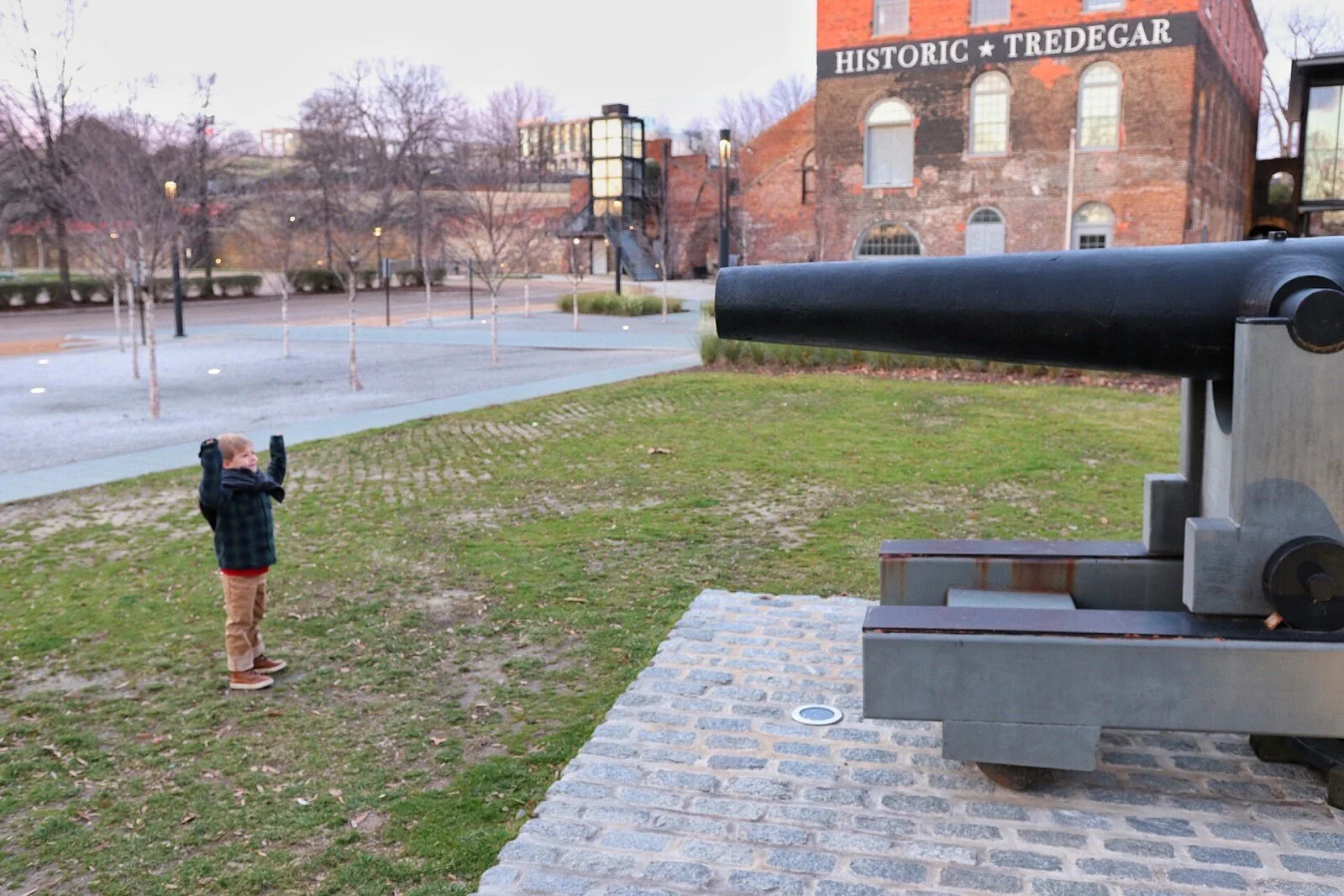
How does a 5-year-old take in local history? By surrendering to a cannon, of course!
Regardless of where I travel or for what reason, I try to fit a little history into the trip. A recent journey to Richmond, Virginia, was no exception, but between family visits and wrangling two grand kids, there was only a sliver of time. Not only were we strapped for time, but by the time the family reunion ended, the local museums were closing their doors for the night.
Thanks to the innovative public approach to history, storytelling, and art, we were still able to enjoy several opportunities, including the T. Tyler Potterfield Memorial Bridge, and the exterior sculptures and interpretation at the Civil War Museum at Tredegar. The Virginia War Memorial, also available after hours, also called to us with its hauntingly illuminated Shrine of Memory. From hamming it up “surrendering” to the cannon, to chatting with Lincoln, we had a blast, and I am doing my best to nourish the next generation of museum geeks. Thank you, Richmond, for assisting with that endeavor!


Finding History in MKE
One of my greatest sources of inspiration is travel. Wherever I go, no matter how large or small, near or far, I try to stop for at least one delightful piece of local history.
One of my greatest sources of inspiration is travel. Wherever I go, no matter how large or small, near or far, I try to stop for at least one delightful piece of local history. If you pay attention, history is everywhere. Just look! On my most recent excursion, I didn’t have to look hard to find a city resplendent with treasures. Milwaukee is one of my favorite places on earth, and I love to stroll the streets and buildings and absorb its vibe.
In December, I had the opportunity to tag along with my partner, who was tasked with boring seminars all day, leaving me free to roam and learn. Armed with Uber and Google maps, I set out to find museums, large and small and find inspiration. And boy, did I. My adventures began at the Milwaukee Public Museum, a huge repository of natural history specimens, but also with extensive historical and ethnological exhibits. I wandered the galleries for hours, thankful for both the professional installations and the warmth (it was 20 degrees outside - a fair bit colder than this desert-dog is accustomed to). http://www.mpm.edu/ From there, I went to the Milwaukee County Historical Society, housed in a fantastic building near the river. Besides getting totally sidetracked by their research room, I was mesmerized by their open storage and workroom areas in the basement. My advice for when you go - enjoy the main level and mezzanine, but don’t forget a trip to the washrooms - its there you will see the behind-the-scenes magic and get to watch curators and archivists doing their thing. http://milwaukeehistory.net/


That evening, I ventured to Downtown Books, a joyfully cluttered bookstore that would tug the heartstrings of any bibliophile. The official mascot, a book-cat greeted me at the door, and I was off to lose myself in the stacks. https://www.downtownbooksonline.com/
Day two dawned bright and cold, so I tasked Uber with transport to my next spot. Milwaukee boasts the National Bobblehead Hall of Fame and Museum. Honestly, I was skeptical. Bobbleheads do not hearken to mind serious scholarship. To my delight, however, the Bobblehead Museum is a great adventure! I had no idea the breadth of this pop culture phenomenon, and I was thrilled to not only find my favorite characters, but plenty of interpretation and narrative. https://www.bobbleheadhall.com/
With only a few priceless days to explore the city, I had to choose carefully. I managed to find the Pabst Historic Brewery and took a tour, slipped into Saint Kate, https://www.saintkatearts.com/, a newer boutique arts hotel with fantastic galleries, and of course, City Hall. City Hall is a sight to behold, with its massive bell tower. Built in that wondrously over the top decade of the 1890s, I couldn’t resist tons of photos from every angle. My Uber driver had suggested I not forego seeing the interior as well, and it did not disappoint. https://city.milwaukee.gov/BasicFacts#.XhXyYUdKg2w
By Friday morning, I knew I had missed so much, and yet, with only hours before my flight, I chose the Milwaukee Jewish Museum. Its temporary signature show was Houdini, and I couldn’t resist. I walked there, past decades of history, and pondered about the people and events that shaped this interesting city. A few of the faces that accompanied me are pictured below. Once at the Museum, I was delighted to find not only an incredible Harry Houdini/Erik Weisz exhibition, but one of the most beautifully-fabricated permanent shows I’ve seen. The Jewish Museum took advantage of every corner to tell a big story in a small space. https://jewishmuseummilwaukee.org/
Praise for MKE could continue - but here, I will stop. This severely disappoints the foodie in me, having neglected to write about Public Market, Birch and Butcher, The Pfister Hotel, The Old German Beer Hall…..and on and on. I’ll save something for next time. And there will be a next time! MKE Love!


A Few Cell-fies for the Files
Maybe it’s just coincidence, or bad luck, hopefully not foreboding, but in 2019, I found myself in jail – often.
Maybe it’s just coincidence, or bad luck, hopefully not foreboding, but in 2019, I found myself in jail – often. The Old Maricopa County Courthouse celebrates its 90th birthday this year, and to commemorate the occasion, Museum Pros was hired to install an exhibit in the Justice Museum on the 6th floor of the most stunning building in downtown Phoenix. The Museum is housed in the historic cell block, which once was home to pretty notorious inmates including Winnie Ruth Judd, the “Trunk Murderess,” and Ernesto Miranda, of “you have the right to remain silent” fame. While working there, I couldn’t help but snap a few cell-fies.
Not to be outdone, another project also involved jail – this time in the City of Peoria, AZ. The old jail building there, a simple and elegant example of WPA work from the 1930s, boasts two jail cells. While evaluating and stabilizing collections on site, I had to try one out. It’s not every day you get to share space of one of societies most forgotten citizens and share the haunting world of the incarcerated. The United States has many prison museums, many doing amazing work in interpreting the complicated histories of these places. Find one today and explore on your own. And while you’re there, but sure to snap a cell-fie or two of your own!

